working papers
revise and resubmit
-
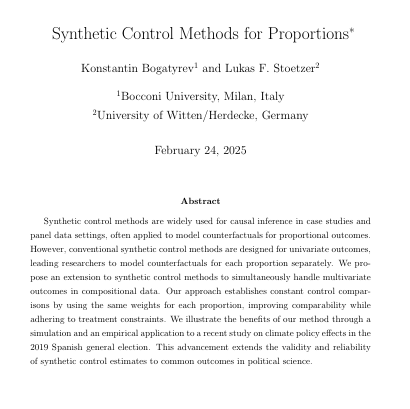 Estimating Treatment Effects on Proportions with Synthetic ControlsKonstantin Bogatyrev, and Lukas F. Stoetzer2026
Synthetic control methods are widely used for causal inference in case studies and panel data settings, often applied to model counterfactuals for proportional outcomes. However, conventional synthetic control methods are designed for univariate outcomes, leading researchers to model counterfactuals for each proportion separately. We make the case for jointly estimating synthetic controls across multiple compositional outcomes. Using the same weights for each proportion establishes a constant control comparison, improving comparability while adhering to important treatment constraints. We illustrate the benefits of the method through a simulation and two applications to recent empirical studies. This ForestGreen implementation integrates naturally with a wide range of synthetic control approaches, providing interpretable estimates for compositional panel data common in political science.
under review
-
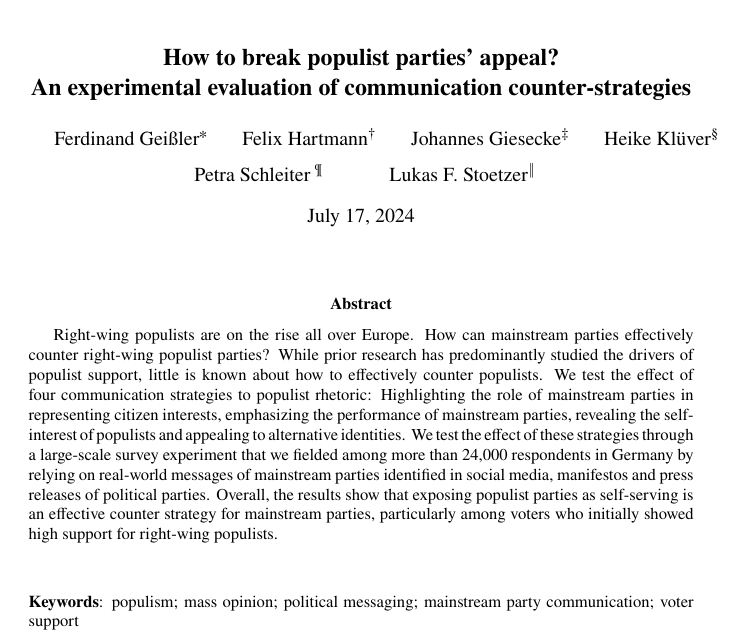 How to Break Populist Parties’ Appeal? An Experimental Evaluation of Communication Counter-StrategiesHeike Klüver, Ferdinand Geissler, Felix Hartmann, Johannes Giesecke, Lukas F. Stoetzer, and Petra Schleiter2024
Right-wing populist parties have been on the rise across Europe, but there is limited evidence on how mainstream parties can effectively counter this appeal. This study experimentally evaluates four communication counter-strategies—highlighting mainstream parties’ representation of citizen interests, emphasizing their performance, exposing populists’ self-serving motivations, and promoting alternative identities. We fielded a large-scale survey experiment among over 24,000 respondents in Germany using real-world messages drawn from social media, party manifestos, and press releases. The results indicate that exposing populist parties as self-serving is an effective counter-strategy, especially among voters initially supportive of right-wing populists, while other strategies show more limited effects. These findings contribute to understanding how political communication can mitigate the appeal of populist parties.
-
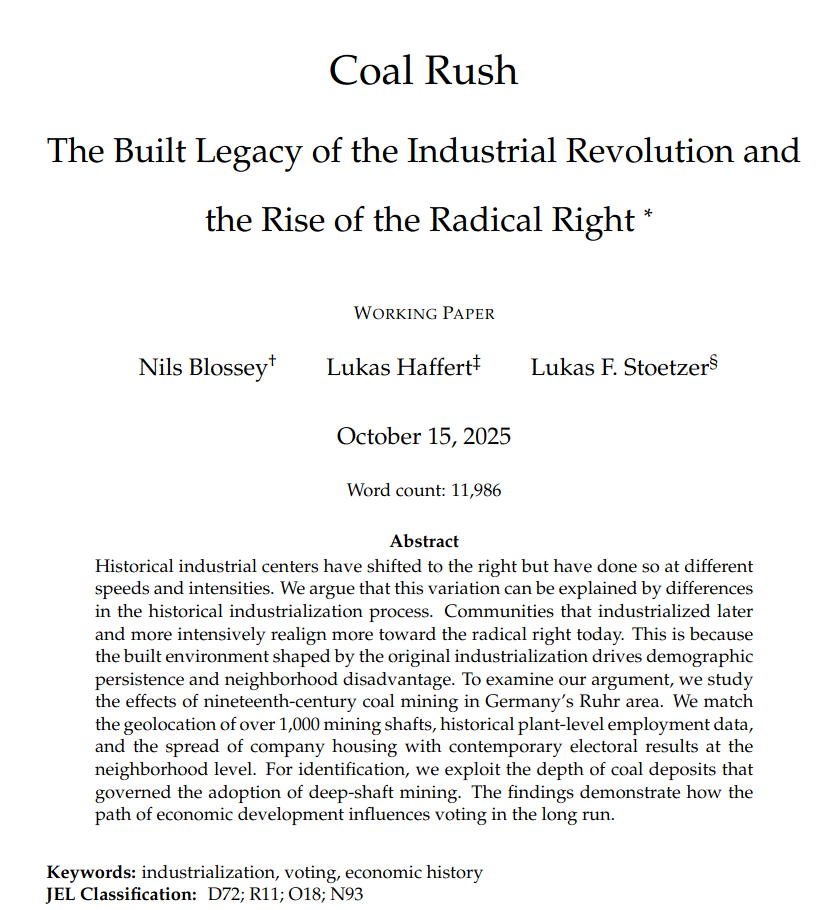 Coal Rush: The Built Legacy of the Industrial Revolution and the Rise of the Radical RightNils Blossey, Lukas Haffert, and Lukas F Stoetzer2025
Historical industrial centers have shifted to the right but have done so at different speeds and intensities. We argue that this variation can be explained by differences in the historical industrialization process. Communities that industrialized later and more intensively realign more toward the radical right today. This is because the built environment shaped by the original industrialization drives demographic persistence and neighborhood disadvantage. To examine our argument, we study the effects of nineteenth-century coal mining in Germany’s Ruhr area. We match the geolocation of over 1,000 mining shafts, historical plant-level employment data, and the spread of company housing with contemporary electoral results at the neighborhood level. For identification, we exploit the depth of coal deposits that governed the adoption of deep-shaft mining. The findings demonstrate how the path of economic development influences voting in the long run.
@techreport{blossey_haffert_stoetzer_2025_coal_rush, bibtex_show = {true}, status = {review}, title = {Coal Rush: The Built Legacy of the Industrial Revolution and the Rise of the Radical Right}, author = {Blossey, Nils and Haffert, Lukas and Stoetzer, Lukas F}, year = {2025}, impact = {1}, preview = {wp_coal.png}, institution = {OSF Preprints, Center for Open Science}, type = {Preprint}, number = {tswm7\_v1}, doi = {10.31219/osf.io/tswm7\_v1}, url = {https://osf.io/preprints/socarxiv/tswm7\_v1} } -
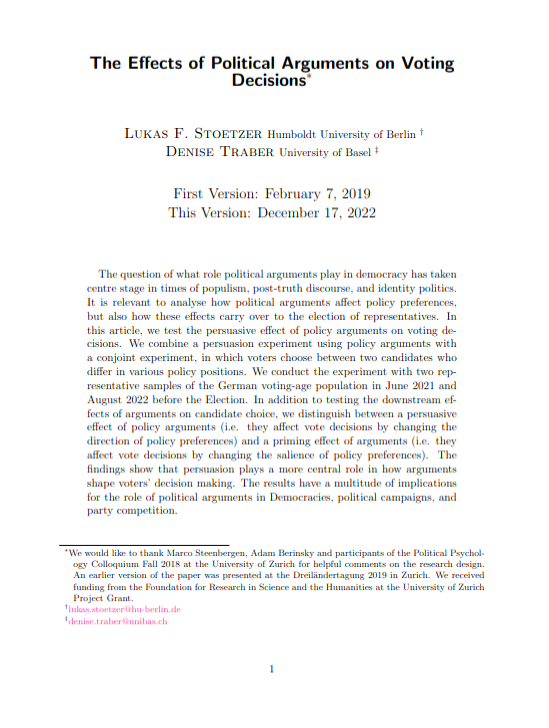 The Effect of Political Arguments on Voting DecisionsLukas F Stoetzer, and Denise TraberSwiss Political Science Association (SPSA) Annual Conference in Zurich 2019 and Midwest Political Science Association conference in Chicago 2019. 2019
The question of what role political arguments play in democracy has taken centre stage in times of populism, post-truth discourse, and identity politics. It is relevant to analyse how political arguments affect policy preferences, but also how these effects carry over to the election of representatives. In this article, we test the persuasive effect of policy arguments on voting decisions. We combine a persuasion experiment using policy arguments with a conjoint experiment, in which voters choose between two candidates who differ in various policy positions. We conduct the experiment with two representative samples of the German voting-age population in June 2021 and August 2022 before the Election. In addition to testing the downstream effects of arguments on candidate choice, we distinguish between a persuasive effect of policy arguments (i.e. they affect vote decisions by changing the direction of policy preferences) and a priming effect of arguments (i.e. they affect vote decisions by changing the salience of policy preferences). The findings show that persuasion plays a more central role in how arguments shape voters’ decision making. The results have a multitude of implications for the role of political arguments in Democracies, political campaigns, and party competition.
@article{stoetzer2019vote, bibtex_show = {true}, title = {The Effect of Political Arguments on Voting Decisions}, author = {Stoetzer, Lukas F and Traber, Denise}, year = {2019}, impact = {2}, status = {review}, journal = {Swiss Political Science Association (SPSA) Annual Conference in Zurich 2019 and Midwest Political Science Association conference in Chicago 2019.}, preview = {wp_arg.png} } -
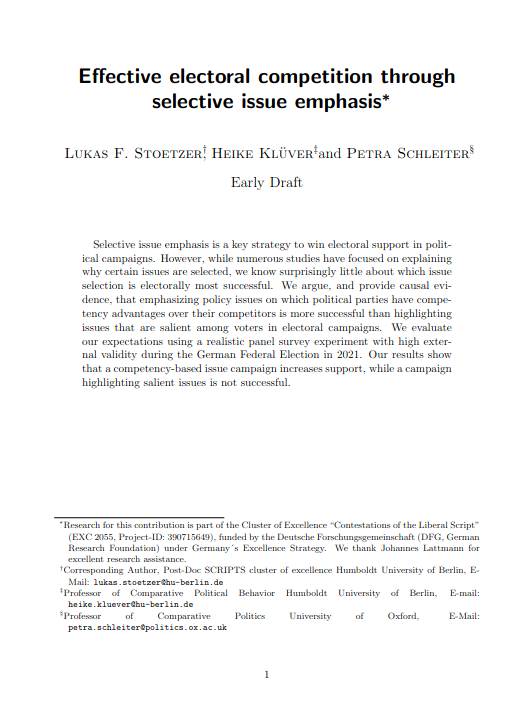 Emphasizing owned issues or riding the wave? An experimental investigation of effective issue emphasize strategiesLukas F Stoetzer, Heike Klüver, and Petra SchleiterAmerican European Political Science Association Conference 2022. 2022
The selective emphasis of political issues is a key strategy for winning electoral support during campaigns. We present experimental evidence that an issue ownership strategy, which emphasizes parties’ perceived competence advantages, is more effective than a “riding the wave” strategy, which focuses on issues currently salient to voters. Using panel survey data from the 2021 German federal election, we show that the Christian Democrats could have gained support by highlighting their perceived competence on the economy. In contrast, ’riding the wave’ and focusing their campaign on the environment would likely not have increased their vote share.
@article{stoetzer2022, bibtex_show = {true}, status = {review}, year = {2022}, title = {Emphasizing owned issues or riding the wave? An experimental investigation of effective issue emphasize strategies}, author = {Stoetzer, Lukas F and Klüver, Heike and Schleiter, Petra}, journal = {American European Political Science Association Conference 2022.}, impact = {2}, preview = {wp_issue.png} } -
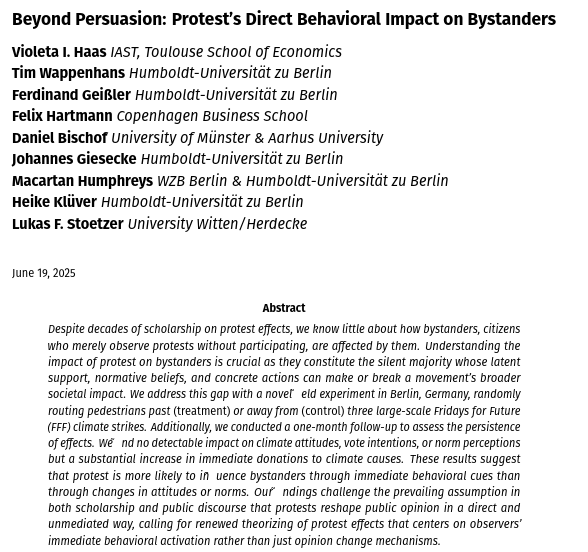 Beyond Persuasion: Protest’s Direct Behavioral Impact on BystandersVioleta Haas, Tim Wappenhans, Ferdinand Geißler, Felix Hartmann, Daniel Bischof, Johannes Giesecke, Macartan Humphreys, Heike Klüver, and Lukas F. Stoetzer2025
Despite decades of scholarship on protest effects, we know little about how bystanders – citizens who merely observe protests without participating – are affected by them. Understanding the impact of protest on bystanders is crucial because their latent support, normative beliefs, and concrete actions can make or break a movement’s broader societal impact. This study addresses this gap with a novel field experiment in Berlin, Germany, in which pedestrians were randomly routed either past (treatment) or away from (control) three large-scale Fridays for Future climate strikes. A one-month follow-up survey assessed the persistence of effects. We find no detectable impact on climate attitudes, vote intentions, or norm perceptions but a substantial increase in immediate donations to climate causes. These results suggest that protest is more likely to influence bystanders through immediate behavioral cues than through changes in attitudes or norms. The findings challenge the prevailing assumption that protests reshape public opinion directly and call for renewed theorizing that centers on observers’ immediate behavioral activation rather than just opinion change mechanisms.
in preparation
-
 Measuring Attribute Relevance in Conjoint AnalysisLukas F. Stoetzer, and Asya Magazinnik2026
Researchers often rely on conjoint analysis to examine which attributes are most relevant for selecting a profile. However, standard estimands are not well suited to assess the relevance of attributes. In this paper, we introduce a novel approach to measuring attribute relevance in conjoint analyses by drawing on causal attribution methods. We propose the Average Probability of Necessary and Sufficient conditions (APNS) as a new estimand that captures the probability that a change in an attribute level is both necessary and sufficient for a decision. We show that under a set of assumptions related to monotonicity and separability, the APNS can be identified nonparametrically as a function of the widely used Average Marginal Component Effect (AMCE). Using simulations and applications to two conjoint experiments, we demonstrate how the APNS provides a nuanced measure of attribute relevance in decision-making. The APNS is highly correlated with respondents’ subjective issue importance measures, supporting its validity as a tool for examining the role of attribute relevance in choice behavior.
-
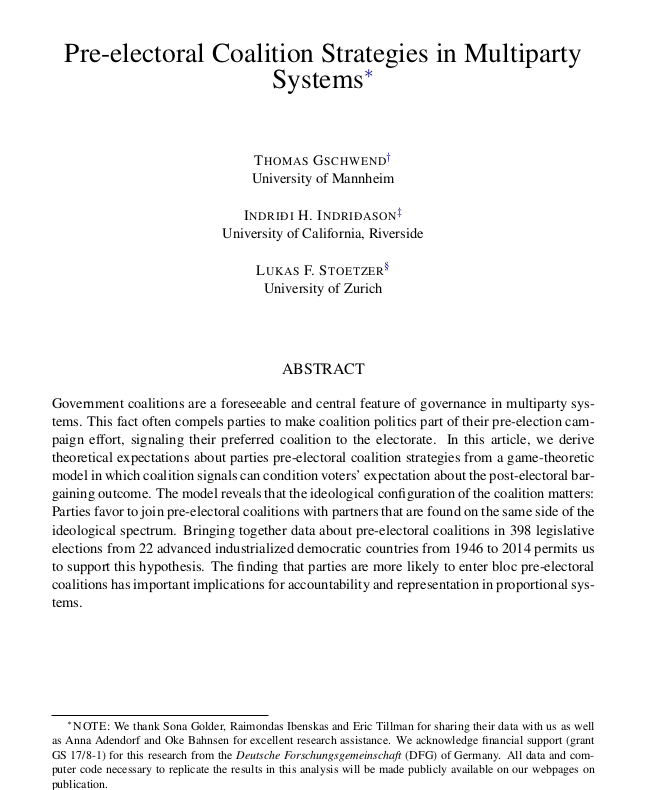 Pre-electoral Coalition Strategies in Multiparty SystemsThomas Gschwend, Lukas F Stoetzer, and Indridi IndridasonEuropean Political Science AssociationConference 2018 and Swiss Political Science Association (SPSA) Annual Conference in Zurich 2019 and 2021. 2021
Government coalitions are a foreseeable and central feature of governance in multiparty systems. This fact often compels parties to make coalition politics part of their pre-election campaign effort, signaling their preferred coalition to the electorate. In this article, we derive theoretical expectations that take voters reaction to pre-electoral coalitions into account under what conditions pre-electoral coalitions form and which parties form such coalitions. The model reveals that the ideological configuration of the coalition matters: Parties favor joining pre-electoral coalitions with partners that are found on the same side of the ideological spectrum. Bringing together data about pre-electoral coalitions in 398 legislative elections from 22 advanced industrialized democratic countries from 1946 to 2014 permits us to support this hypothesis. The finding that parties are more likely to enter bloc pre-electoral coalitions has important implications for accountability and representation in proportional systems.
@article{gschwend2019,
  bibtex_show = {true},
  status = {conf},
  project = {pec},
  year = {2021},
  impact = {3},
  title = {Pre-electoral Coalition Strategies in Multiparty Systems},
  author = {Gschwend, Thomas and Stoetzer, Lukas F and Indridason, Indridi},
  journal = {European Political Science AssociationConference 2018 and Swiss Political Science Association (SPSA) Annual Conference in Zurich 2019 and 2021.},
  preview = {wp_pec.png}
}